
Flag Wars
Revisiting a 2020 Culture War Skirmish

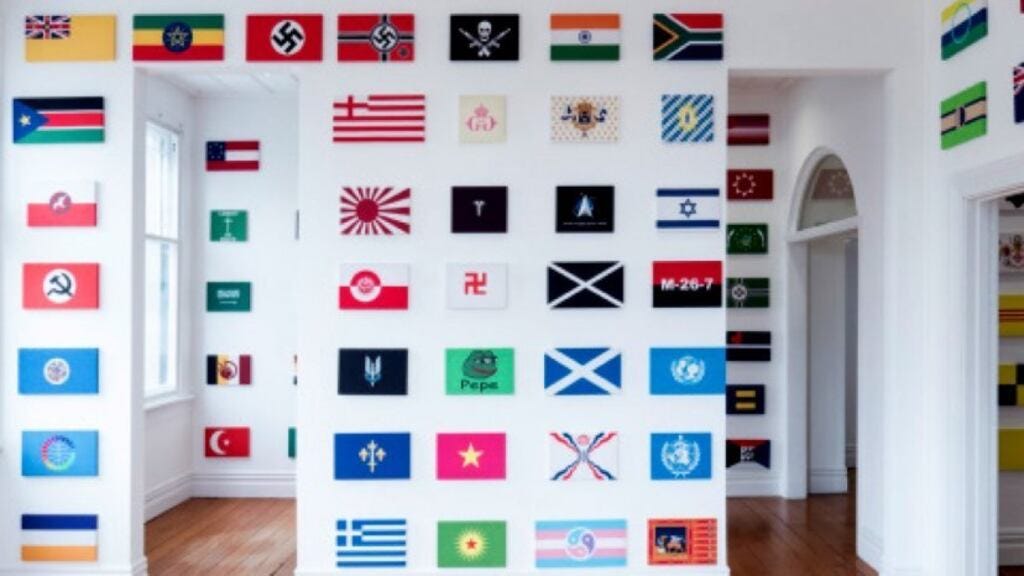
In 2020, I was asked by a group of New Zealand artists called Mercy Pictures to write “anything at all” to accompany their show “People of Colour”, to be held in Aukland that Autumn. I hadn’t met the artists in person and I’ve never been to New Zealand: after all that transpired I’m not sure I want to, though I hear the nature is sublime. The exhibition would “consist of 365 flags printed on fabric and stretched which will cover all the walls of our new gallery.” As you can see from the above photograph, these “flags” were around postcard-sized and their size and reproduction raised a question, among others, of what counts as a flag (is a copy of a flag a flag? When is a flag an original, and when is it a “flag-in-quotation”?). In any case, I sent them a short original text, republished below:
…..
A flag is a piece of material, stuck to a wall, hoisted on a flag-pole. From a scientific standpoint, a flag, any flag, is nothing, just a scrap of cloth. In this sense, then, flags are silly. To care about flags is to expose oneself as vulnerable to a certain symbolic dominance. To pledge allegiance to a flag, any flag, unless done under duress, out of a cultural habit, is a strange move in a world shimmering, exploding with floating signifiers. What differentiates a McDonalds sign from the Stars and Stripes? Why not kneel outside a Dunkin’ Donuts instead? What is capitalism’s flag – all of the banners flapping outside consumer huts strewn across the world, perhaps?
Dread Scott’s 1988 installation ‘What Is The Proper Way to Display a US Flag?’ sets the bar high for flag art. In this piece, visitors must decide whether to step on an American flag on the floor in order to answer the question in a ledger-book that sits on a shelf above it. Toying with desecration, and highly controversial – President Bush Senior declared the flag ‘disgraceful’ and the entire US Congress denounced the work, voting to in the Senate 97-0 to outlaw displaying the US flag on the floor or the ground – Scott’s work reveals the murky potential offence that a flag always ominously signals, even if stepping on a flag, or even burning one, on another level, is physically indistinguishable from setting fire to a large dishcloth. But the feelings!
This was a summer of flags. Britain was over-run by rainbows. Formerly the Pride flag, celebrating gays, lesbians and bisexuals, the rainbow has lately been commandeered by the National Health Service as a happy, positive symbol of what might come after the Pandemic, or perhaps more realistically, a desperate attempt in the present to keep people happy in the face of fear, loneliness and economic desolation. Every street in the city has a rainbow. Children have drawn or painted their own, ragged versions and parents have put them in their windows. There is something tyrannous about this rainbow flag. It seems to say, there is no nature left, no natural rainbows. All we have are these desultory fake rainbows with their too-bright colours. There is only the city, and waves of illness, and lockdowns, and you have to pretend you are enjoying it and that we are all in this together.
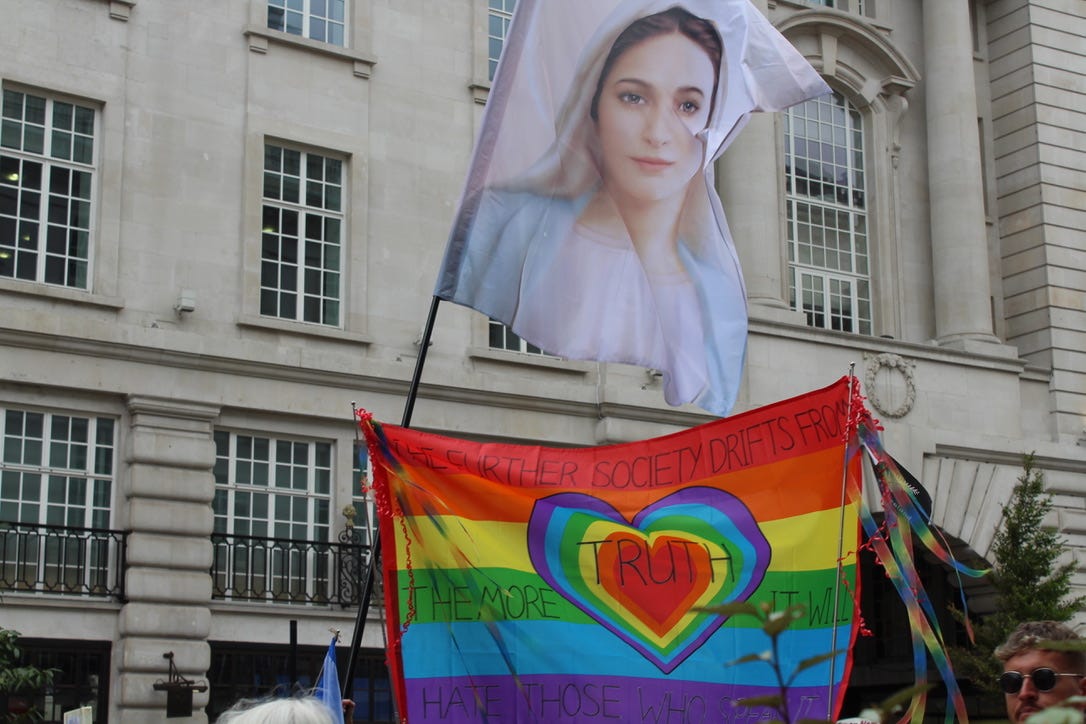
A forced flag is a menacing object. What if your flag is not my flag? What if I want nothing to do with your beliefs? Does nature need flags? I don’t think so. Flags are human, horribly so. They are always strangely evocative, even if we refuse, in our cynicism, to be moved by them. The respect and reverence of others for flags can seem archaic, primitive…and symbols aren’t real, a flag is not a country. And yet people take great stock by them, we read everything into the flags that someone chooses to display as a reflection of their being, their belonging. We all detest or are afraid of certain flags, we are touched by others. They menace us, haunt us, even as fewer places seem stable enough to even display them…
What, in this sense, are flags on the internet? Traditional flags are massive: our virtual lives are shrunken, creating all the more need for people to posit their identity for fear of falling into the void. Flags have become emojis, tiny rectangular blocks next to names or pseudonyms. If we shrink the flag, do we diminish its power or expand it? People of Colour at Mercy Pictures engages in a semiotic provocation both at the level of scale and at the level of meaning. If you put all the flags together – or if not all the flags, enough flags that the very idea of ‘flag’ itself begins to shudder under the weight of multiple confusing impressions – do they cancel each other out? Repeating a familiar word makes it start to sound uncanny, meaningless. All these small postcard-sized flags, sized somewhere between online symbol and landscape painting: perhaps an incitement, a red flag. Identity is over: a flag is a flag is a flag.
…..
In the wake of today’s flag wars, what strikes me about my commentary is how tepid it is, how distanced from the possibility that flags can be revitalised. It remains on the side of ironic detachment. The Mercy Pictures show was much more interesting than my text, and much more prescient. At the time of writing, I had grown weary of the various iterations of the “Pride” flag being flown over streets and at multiple institutions, and, at this point, of the rainbow that became the symbol of the pandemic in the UK, and the various ways in which these inorganic flags had become ubiquitous. But I hadn’t yet understood the double nature of flags as both marker of domination and symbol of resistance. “A forced flag is a menacing object” I wrote.
The progressive regime certainly understood the power of the flag, as evidenced by the fact that various iterations of the “Progress” flag flew over every institution, from universities to churches. There was nothing organic about this: this was a declaration of power. If you refused to accept the flag and everything it represented—child mutilation, disordered sexuality, the demand of narcissists for total acquiescence—you were the enemy and fair game for economic and social sanction.
Back in 2020, the young New Zealand artists were hounded and attacked by so-called “antifa” who nominally objected to the inclusion of Maori symbols alongside National Socialist banners. The whole thing got extremely out of hand, with the artists forced into hiding, my text unpublished, and we all got denounced by various New Zealand media outlets as “Nazis” and whatever black magic words people have now used up. The events were written up beautifully by New Zealand James Robb in a piece, “A Witch-hunt devastates the Auckland art world” and by Daniel Miller for the Critic. Mercy Pictures continue to exist, at least in the form of an Instagram account. I wish them luck and love wherever they are.
The hysteria around “People of Colour”, characteristic of the past decade or so, and nowhere more so than the art world, a fragile creature held together by ego, delusion and money-laundering, detracted from the exhibition itself, which was that rare thing: intelligent. The losers who attacked it did so, as ever, on the grounds of idiotic literalism (Nazi flag bad!), without pausing to reflect for a moment whether or not they were implicated in totalitarian propaganda of their own (answer: yes they were). The attack on Mercy Pictures was because their show (much like, say, the NPC meme) drew back the curtain on progressivism, exposing it for the particularly deranged and aggressive ideology that it was. They were an occupying army of the mind, with loyalty oaths, denunciations and people desperately staying silent or acquiescing out of fear of being next. Progressivism permitted the sadistic and pathocratic element of the population to persecute others in the name of “minorities”, “the oppressed” or whatever passive-aggressive cudgel they could invoke that week.
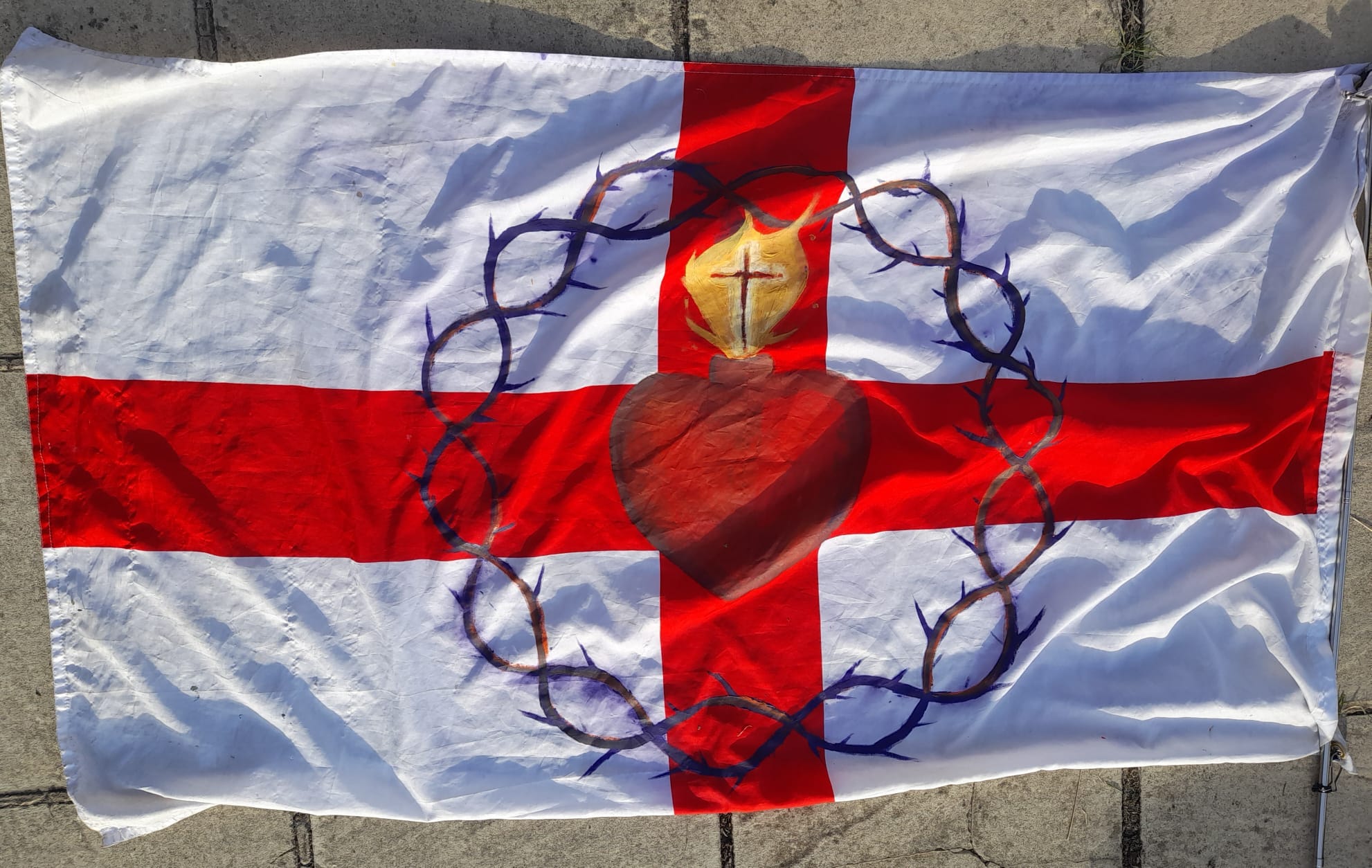
In the wake of the recent hoisting of the flags, documented by Flag Force UK, what the Mercy Pictures show had tried to show within the walls of gallery is played out on the streets: a flag is never merely a flag, but a declaration of energy. A country without a flag is no country at all.
Brilliant post. I used to laugh when I visited the States in my twenties and thirties, at the fact that so many houses, especially in the suburbs, would be proudly flying flags, each of them seemingly trying to outdo the other in their enthusiasm. My impression was that it was a very weird thing to do, the sort of thing people did on mountains, or the moon, or during explorations, to say "I was here first". I literally couldn't conceive of any other reason. What a massive difference twenty, or ten, or even one year, makes, in these febrile times. Did the UK as a country have that kind of spiritual/psychic energy then and if not when was it lost? Or is this process a bit like the Reformation - imposed by the elites while the ordinary folk held onto their old beliefs (and were persecuted for doing so).